When an Ussing Chamber Is the Right Tool and When It Is Not
Ussing chambers are powerful tools, but they are often chosen for the wrong reasons.
Many researchers encounter the technique early in training and assume it applies broadly. In practice, Ussing chambers excel in specific experimental situations and perform poorly in others.
This overview is meant to help researchers decide when an Ussing chamber is appropriate and when another approach is better.
What Ussing chambers are good at
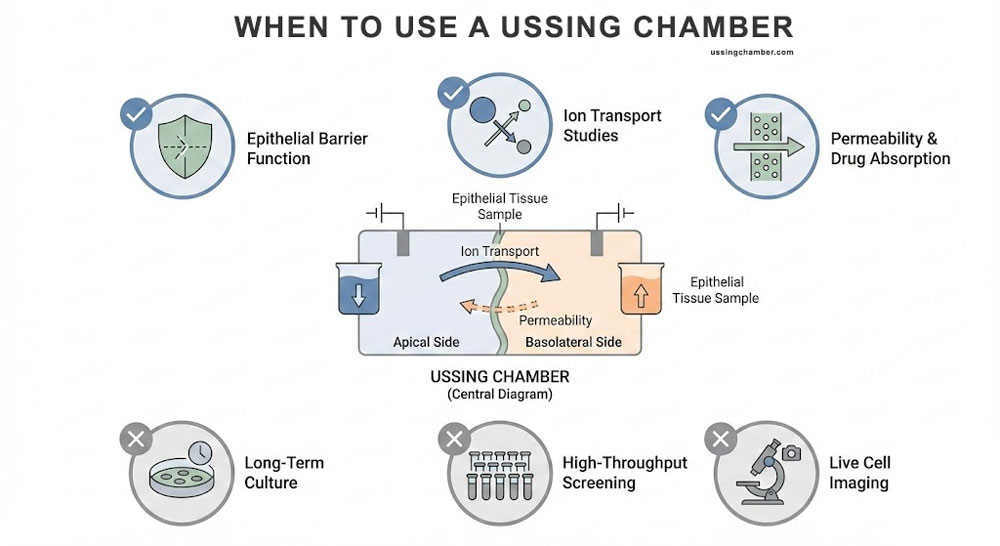
Ussing chambers are best suited for experiments that require:
-
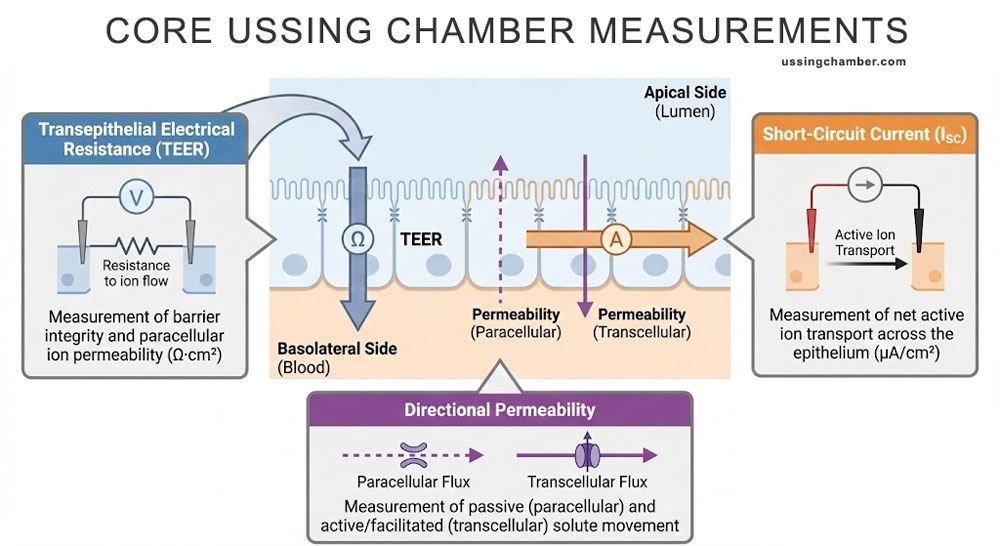
Measurement of epithelial barrier function
-
Directional ion transport under voltage-clamp conditions
-
Short-term drug transport and permeability studies
-
Functional physiology of intact tissues or polarized cell layers
When properly used, they provide direct, quantitative insight into epithelial transport mechanisms.
What Ussing chambers are not designed for
Ussing chambers are not ideal for:
-
Long-term cell culture or chronic exposure studies
-
High-throughput screening
-
Imaging-focused workflows
-
Structural or morphological analysis
Attempting to use an Ussing chamber for these purposes often leads to compromised data or unnecessary complexity.
Common cases of tool mismatch
Labs frequently choose Ussing chambers when:
-
A simpler TEER plate would answer the same question
-
Cell-based permeability assays are sufficient
-
Organ-on-chip systems are better suited to the biology
Conversely, Ussing chambers are sometimes avoided when intact tissue physiology is actually required.
A simple decision checkpoint
An Ussing chamber is likely appropriate if your goal is to:
-
Measure active transport
-
Compare apical versus basolateral flux
-
Assess epithelial integrity under controlled electrical conditions
If your goal is long-term culture, imaging, or screening hundreds of compounds, another platform is usually a better fit.
What changes once you commit to the method
Once an Ussing chamber is the right tool, execution quality matters.
At this stage, experimental outcomes depend heavily on:
-
Chamber geometry and sealing
-
Tissue handling and mounting consistency
-
Electrical stability and noise control
-
Operator-to-operator reproducibility
These factors are rarely discussed in introductory descriptions but strongly influence data quality.
This article explains when the method itself is appropriate. Ussing Chamber System-level design considerations and advanced implementation details are covered in depth at Physiologic Instruments, where reproducibility and experimental reliability are the focus.